

Dayparting on bol.com: stop wasting budget on dead hours | Advindix
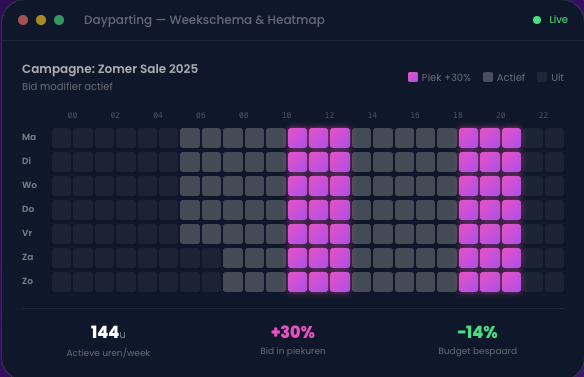
Your advertising campaign on bol.com runs 24 hours a day, 7 days a week. Sounds good — but is it? The reality is that your customers don't shop 24/7. At night they sleep. On a Tuesday morning at 06:00, almost nobody buys a kitchen appliance. Yet you're still paying into the auction.
Dayparting is the solution. In this article we explain what it is, why it's so powerful for bol.com sellers, and how to apply it in practice.
What is dayparting?
Dayparting means setting different budgets or bids per hour of the day and day of the week. Instead of one fixed bid that's always active, you decide: at which moments do I want to go full throttle, and when do I pull back?
The concept originally comes from the TV advertising world, where prime time evening slots were always more expensive than Sunday mornings. The same principle applies to online advertising.
On platforms like Google Ads and Meta Ads, dayparting has been standard for years. On bol.com this was until recently completely unavailable through the native interface — and with most advertising tools either.
Why is dayparting so important on bol.com?
bol.com has specific buying behaviour that varies strongly by hour. From data across bol.com sellers we consistently see the same patterns:
Peak hours on bol.com:
- Lunch break (12:00–13:30): Many people browse and buy during their break
- Evening rush (19:00–22:00): The busiest moment of the day — couch, phone, impulse purchases
- Saturday afternoon (13:00–17:00): High purchase intent, including larger items
Off-peak hours on bol.com:
- Night (23:00–06:00): Minimal activity, but you're still paying into the auction
- Early morning (06:00–09:00): Few conversions, though competitors also bid lower
If you pay the same cost per click at night as during the evening rush, you're wasting money. Not because the clicks don't happen — but because those clicks convert significantly less.
The calculation: what does it cost without dayparting?
Say your daily budget is €50 and your average CPC is €0.40. That's 125 clicks per day.
Without dayparting those clicks are spread across 24 hours. Roughly 20–25 clicks fall in the night (23:00–07:00), a period with 60–70% fewer conversions.
That's €8–€10 per day effectively wasted. Per month: €240–€300 in budget with no return.
With dayparting you redirect that budget to the evening peak, where the conversion rate is 2–3x higher. The result: more orders from the same budget — a higher ROAS.
How does dayparting work in practice?
Good dayparting tools give you a 7×24 grid (7 days × 24 hours = 168 time slots). Per slot you set:
- Budget multiplier: e.g. 150% during the evening rush, 30% at night
- Bid adjustment: e.g. bid 20% higher on Saturday afternoon
- Fully pause: at moments you know with certainty won't convert
A typical schedule for a Dutch consumer product:
| Time slot | Budget | Reason |
|---|---|---|
| 00:00–07:00 | 20% | Barely any active buyers |
| 07:00–12:00 | 60% | Morning, moderate purchase intent |
| 12:00–13:30 | 130% | Lunch peak |
| 13:30–19:00 | 80% | Normal |
| 19:00–22:00 | 150% | Evening rush — highest conversions |
| 22:00–24:00 | 50% | Winding down |
Note: the optimal schedule varies by product category. Fast-moving consumer goods have different peak hours than electronics or garden furniture. Always analyse your own data before setting a schedule.
What does dayparting deliver?
Among Advindix users we see after activating dayparting on average:
- ROAS +25–45% in the first 30 days
- ACoS -15–25% because budget is deployed more efficiently
- Same or higher revenue — but with less wasted budget
The beauty is that you're not advertising less. You're advertising smarter.
Seasonal patterns and special events
Dayparting works not just at a daily level — think about weekly and seasonal patterns too:
- Monday morning: People orient themselves after the weekend but buy less. Lower bids.
- Friday evening: Higher purchase intent, especially for products people use over the weekend.
- Sinterklaas/Black Friday: Consider temporarily adjusting your whole schedule — demand peaks massively outside evening hours too.
For seasonal events, use a combination of dayparting and seasonal planning ideally, so you set everything months in advance and don't have to think about it on the day itself.
Why is dayparting so rare on bol.com?
bol.com does not offer dayparting in its native interface. Most third-party tools don't either — it requires a direct API connection with the bidding logic plus a system that automatically implements the adjustments at the right hour.
Advindix is currently the only Dutch tool that offers hour-by-hour dayparting for bol.com advertising. You set the schedule once, and it runs automatically after that — even while you sleep.
Frequently asked questions
Should I pause my campaign at night?
No, pausing completely is rarely optimal. Even at 20% budget during off-peak hours you can still capture cheap clicks from early shoppers.
How long before I see results?
Most sellers see a ROAS improvement within 2 weeks. After 30 days you have enough data to refine your schedule further.
Does the same schedule apply to every campaign?
No. Automatic and manual campaigns behave differently. Set a separate schedule per campaign type.
Conclusion
Dayparting isn't an advanced trick — it's simply thinking logically about when your customers buy. By aligning your budget and bids with actual buying behaviour on bol.com, you get more return from the same budget.
Want to get started? Try Advindix free for 14 days and set up your first dayparting schedule. No credit card required.
Ready to advertise smarter?
Try Advindix free for 14 days. No credit card needed.