

TaCoS on bol.com: calculate, benchmark and improve | Advindix
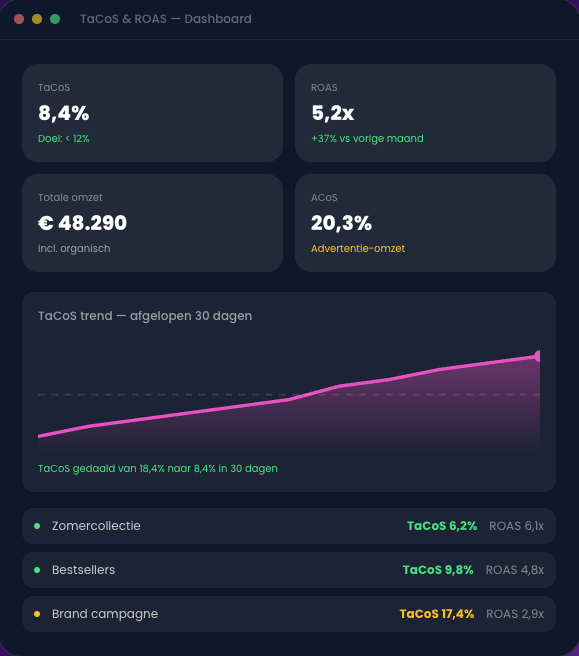
As a bol.com seller you're probably familiar with ACoS — the ratio between advertising costs and advertising revenue. But there's a better metric that most sellers overlook: TaCoS.
TaCoS stands for Total Advertising Cost of Sales and tells you something ACoS cannot: how healthy your advertising strategy is relative to your total business.
ACoS vs. TaCoS: what's the difference?
ACoS (Advertising Cost of Sales)
ACoS = Advertising costs ÷ Revenue from ads × 100
ACoS only measures revenue generated directly through an ad click. Organic purchases are not included.
TaCoS (Total Advertising Cost of Sales)
TaCoS = Advertising costs ÷ Total revenue (organic + ads) × 100
TaCoS divides your advertising costs by your total revenue. This gives a far more realistic picture of what your campaigns actually cost.
A concrete example
Say you had in one week:
- €400 in advertising costs
- €1,200 in revenue from ads
- €800 in organic revenue
- €2,000 in total revenue
Then:
- ACoS = €400 / €1,200 = 33%
- TaCoS = €400 / €2,000 = 20%
Your ACoS might look high (33%), but your TaCoS of 20% shows that your ads are contributing to a healthy total revenue — including the organic flywheel they help drive.
Why is TaCoS a better metric?
Advertising also increases organic discoverability. Every click, every purchase and every positive review you generate through ads strengthens your organic position on bol.com.
With ACoS alone you can't see this effect. You might even decide to stop a successful campaign based on a "high" ACoS, while that campaign is responsible for a large part of your organic growth.
TaCoS reflects the true health of your business:
- TaCoS declining over time? → Your organic revenue is growing faster than your ad spend. Good sign.
- TaCoS rising? → You're becoming too dependent on paid traffic.
- Stable TaCoS with rising revenue? → Your scaling advantage is working.
What is a good TaCoS on bol.com?
| Situation | Expected TaCoS | Explanation |
|---|---|---|
| Launching a new product | 20–35% | You need ads to grow organically |
| Growing bestseller | 10–20% | Organic is gradually taking over |
| Established product | 5–12% | Few ads needed, strong organic |
| Commodity / low margin | <8% | Advertising is barely profitable |
Rule of thumb: your TaCoS must be lower than your gross margin. If your margin is 25% and your TaCoS is 28%, you're losing money. If your TaCoS is 10% with a 25% margin, you're making 15% net margin — that's healthy.
How do you improve your TaCoS?
1. Grow your organic revenue
This is the most powerful lever. The better your organic position, the lower your TaCoS — without cutting ad spend. You do this by:
- Generating more reviews through follow-up emails
- Optimising your content score on bol.com (title, images, description)
- Improving your conversion rate (better photos, competitive pricing)
2. Prune unprofitable search terms
Use the search term report to identify terms that get many clicks but barely convert. Block those terms — this lowers both your ACoS and TaCoS.
3. Use dayparting
By concentrating your budget on peak hours you improve your conversion rate per euro spent. Same budget, more orders — lower TaCoS.
4. Adjust your bidding strategy per phase
- Launch phase: accept a higher TaCoS (15–30%) to build reviews and ranking
- Growth phase: optimise towards 10–15%
- Stable phase: aim below 10%, focus on profitability
Tracking TaCoS: how do you do it?
bol.com does not show TaCoS natively in its reports. You have to calculate it manually by combining advertising revenue with total sales data.
Advindix calculates TaCoS automatically per campaign, per keyword and per product — so you always have an up-to-date overview and instantly see where you're profitable and where you're not.
TaCoS by product type
Seasonal products (paddling pools, Christmas decorations): a high TaCoS in season is normal — rely on the total seasonal margin.
Evergreen products (household items, office supplies): aim for a structurally low TaCoS of <12%.
New releases: accept 25–40% TaCoS in the first 8–12 weeks. After that, organic revenue must grow alongside it and TaCoS must come down.
Frequently asked questions
Should I ignore ACoS entirely?
No. ACoS is useful for optimising individual campaigns. TaCoS is the strategic metric — look at both.
What if I have no organic revenue?
Then ACoS and TaCoS are almost equal. That's a signal your product isn't ranking organically yet — extra reason to focus on TaCoS.
How quickly will I see TaCoS improve?
After structural adjustments (better targeting, dayparting, search term blocks) TaCoS moves within 4–8 weeks. Organic growth takes longer: 2–4 months.
Conclusion
TaCoS is the metric that puts your ACoS into context. It tells you whether your ads are contributing to a healthy, growing business — or whether you're becoming too dependent on paid traffic.
Start tracking TaCoS alongside ACoS. Set a TaCoS target per product based on your margin. And use that data to make smarter decisions about budgets, bids and search terms.
Want to track TaCoS automatically per campaign and product? Try Advindix free for 14 days — no credit card required.
Ready to advertise smarter?
Try Advindix free for 14 days. No credit card needed.